
Menu

2025 Report Volume 2
 December 9, 2025
2025 Report – Volume 2
Scroll to view each audit chapter separately.
This 2025 Report – Volume 2 delivers legislators and the public critical information on whether the Government issued reliable financial statements, used effective processes to administer programs and services, and complied with governing authorities. It includes the results of audit examinations of different agencies completed by November 7, 2025, with details on performance and annual integrated (financial) audits, as well as our follow-up audit work on previously issued recommendations by our Office and agreed to by the Standing Committees on Public Accounts or on Crown and Central Agencies.

2025 Report V2 Highlights Video
Provincial Auditor of Saskatchewan's Overview
Tara Clemett's Complete Overview 2025 Report – Volume 2
Annual Integrated Audits
2 Global Transportation Hub Authority
4 Lotteries and Gaming Saskatchewan Corporation—Saskatchewan Indian Gaming Authority Inc.
6 Saskatchewan Health Authority
8 Summary of Implemented Recommendations
Performance Audits
9 Corrections, Policing and Public Safety—Supporting the Mental Health of Correctional Workers
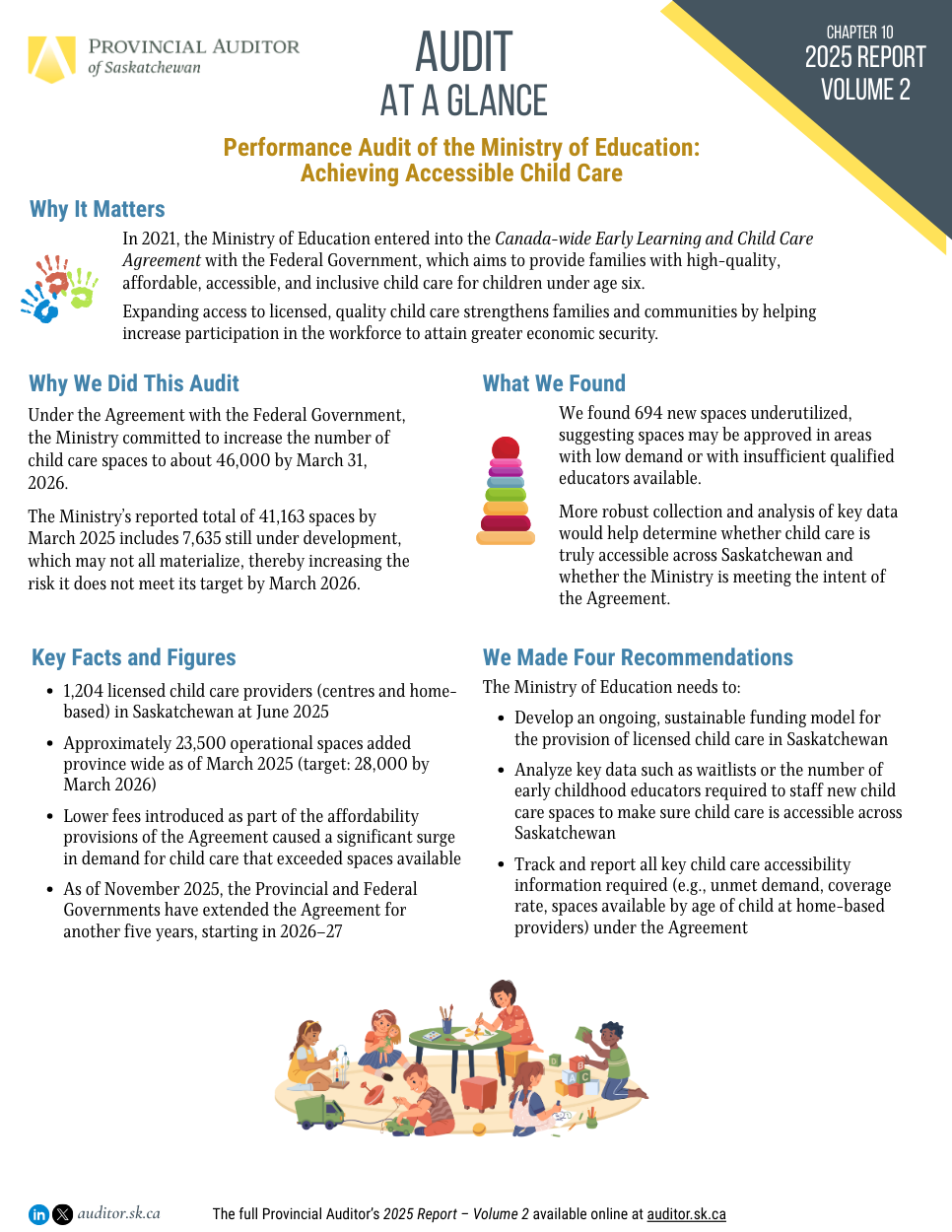
10 Education—Achieving Accessible Child Care
Audit At a Glance Education—Achieving Accessible Child Care
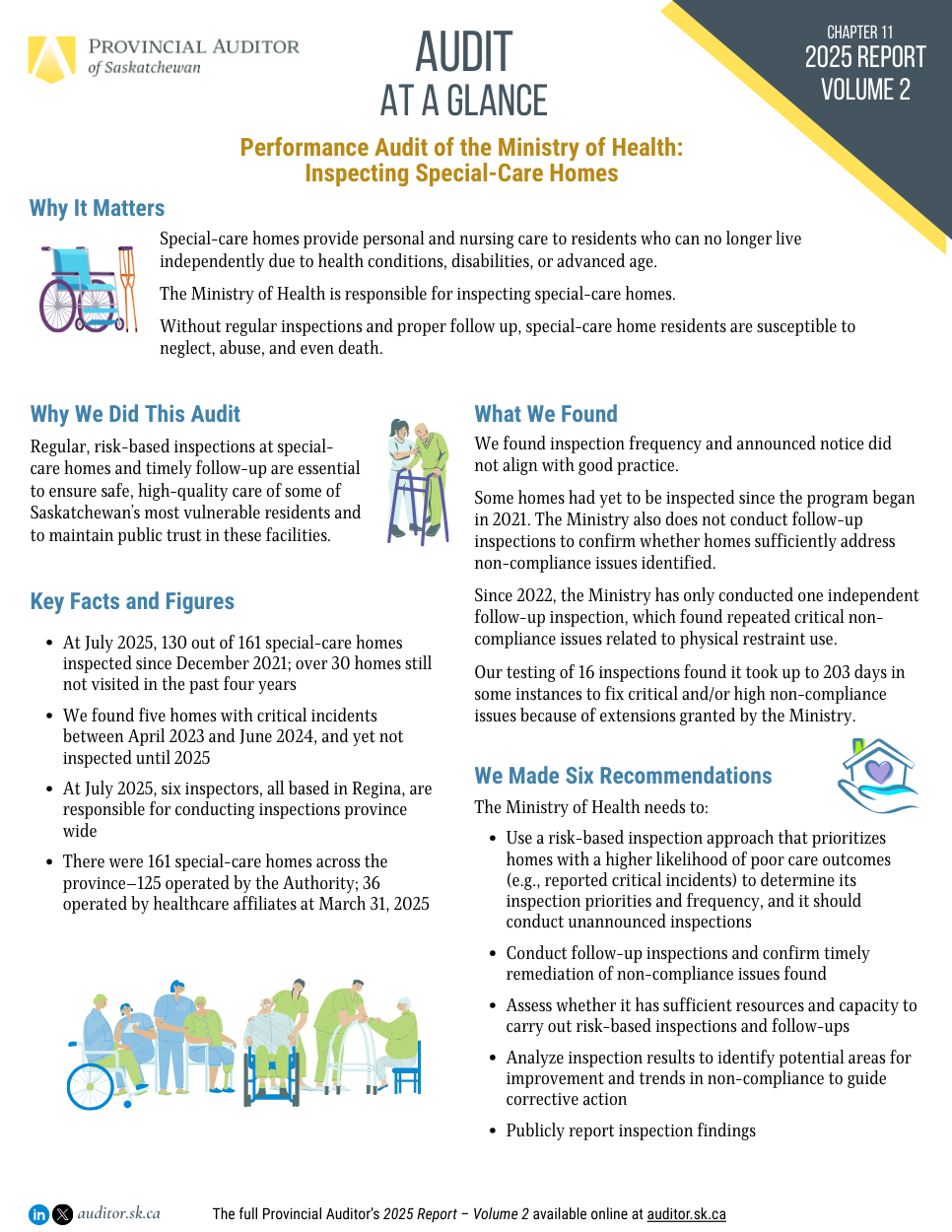
11 Health—Inspecting Special-Care Homes
Audit At a Glance Health—Inspecting Special-Care Homes
12 Parks, Culture and Sport—Protecting Provincial Park Ecosystems
13 Saskatchewan Municipal Board—Providing Timely and Supported Municipal Appeal Decisions
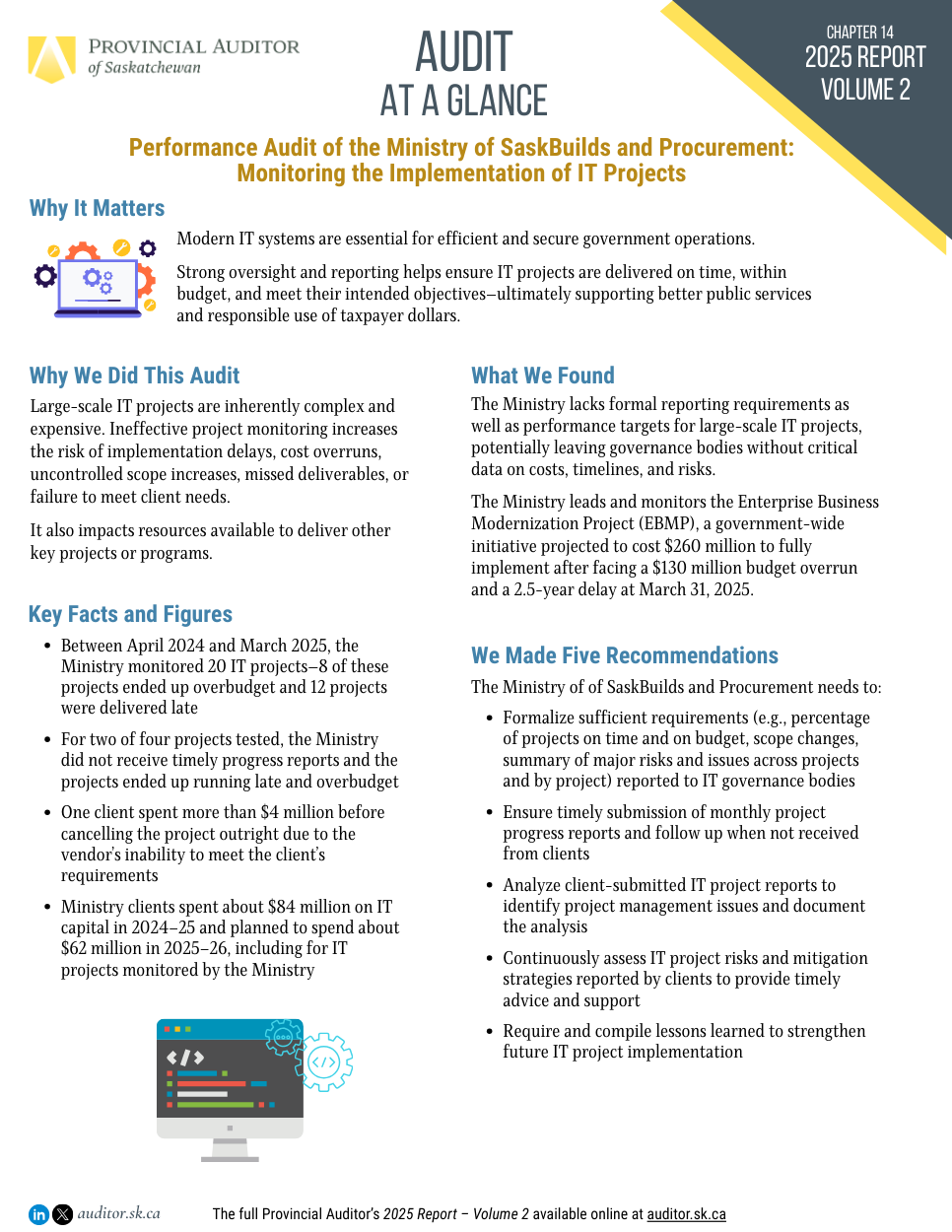
14 SaskBuilds and Procurement—Monitoring the Implementation of IT Projects
Audit At a Glance SaskBuilds and Procurement—Monitoring the Implementation of IT Projects
Follow-Up Audits
15 Education—Evaluating the Early Learning Intensive Support Program
16 Health—Monitoring Enforcement of Tobacco and Vapour Products’ Legislative Requirements
17 Health—Providing Special Needs Equipment for Persons with Disabilities
18 Justice and Attorney General—Conducting Timely and Accurate Coroner Investigations
19 Parks, Culture and Sport—Drinking Water in Provincial Parks
20 Saskatchewan Cancer Agency—Delivering the Screening Program for Colorectal Cancer
21 Saskatchewan Distance Learning Centre—Supporting Students to Complete Distance Education Courses
22 Saskatchewan Gaming Corporation—Preventing Cyberattacks
23 Saskatchewan Government Insurance—Licensing Commercial Drivers
24 Saskatchewan Health Authority—Filling Hard-to-Recruit Healthcare Positions
25 Saskatchewan Health Authority—Minimizing Employee Absenteeism in Kindersley and Area
26 Saskatchewan Health Authority—Overseeing Contracted Special-Care Homes in Saskatoon and Area
28 Saskatchewan Polytechnic—Supporting Success of Indigenous Students
29 Saskatchewan Workers’ Compensation Board—Administering Psychological Injury Claims
Standing Committees
30 Standing Committee on Crown and Central Agencies
31 Standing Committee on Public Accounts
Appendices
1-1 Agencies Subject to Examination under The Provincial Auditor Act and Status of Audits
2-1 Report on the Financial Statements of Agencies Audited by Appointed Auditors
Media Materials 2025 Report – Volume 2
- Compilation of All Audits' Main Points/Executive Summaries
- 2025 Report V2: Achieving Accessible Child Care NEWS RELEASE
- 2025 Report V2: Inspecting Special-Care Homes NEWS RELEASE
- 2025 Report V2: Monitoring IT Project Implementation NEWS RELEASE
- 2025 Report V2: BACKGROUNDER
All Prior Reports
All prior reports are available here for your reference.
Annual Integrated Audits
Since our 2025 Report – Volume 1, our Office, along with appointed auditors (if in place), completed annual integrated audits of about 160 different agencies with fiscal year-ends between January 2025 and July 2025. These include integrated audits of 17 ministries, 28 Crown corporations and agencies, 21 pension and employee benefit plans, and 34 healthcare affiliates.
This Report includes concerns at seven agencies, four of which are highlighted in this section. This means most agencies had effective financial-related controls, complied with financial and governance-related legislative authorities, and prepared reliable financial statements.
The Global Transportation Hub Authority (Chapter 2) did not have well-defined collaboration procedures for major developments at the Hub. Having such procedures would reduce the likelihood of the Authority competing with developers in nearby municipalities (e.g., City of Regina, RM of Sherwood) for future major land developments and would provide a consistent and rigorous consultation process.
The Saskatchewan Indian Gaming Authority Inc. (SIGA) (Chapter 4) needs to ensure its reporting, policies, and procedures support compliance with the Proceeds of Crime (Money Laundering) and Terrorist Financing Act and regulations. In August 2025, the Financial Transactions and Reports Analysis Centre (FINTRAC)—Canada’s financial intelligence unit and anti-money laundering and anti-terrorist financial supervisor (i.e., regulator)—issued a notice of violation and an administrative penalty of $1.175 million to SIGA. Administrative penalties can negatively impact SIGA’s distribution of income to Lotteries & Gaming Saskatchewan. SIGA planned to appeal the notice of violation and penalty to the Federal Court of Canada as of September 2025.
Northlands College (Chapter 5) did not restrict access to its cheque-signing system to properly segregate duties related to making payments. This increases the risk of inappropriate or fraudulent payments going undetected, as one person may be able to create, approve, and process a payment without involving another person. Also, the 2024–25 financial statements of Northlands College are not reliable because they contain a significant $1.8 million error in recording grant revenue. Northlands College received $1.8 million from the Ministry of Education to fund child care spaces at the College but had not begun developing those spaces. Therefore, the College had not yet earned nor was entitled to keep the funding yet. Inaccurate financial statements can impact the ability to make informed financial decisions.
The Saskatchewan Health Authority (Chapter 6) implemented certain aspects of the Administrative Information Management System (AIMS) in June 2024. Our user access review in AIMS identified 19 users with the ability to enter and approve invoices. The Authority needs to regularly monitor whether users with these conflicting roles actually process payments without involving others. Additionally, AIMS created challenges in preparing sufficient and timely financial reconciliations like bank reconciliations in 2024–25. Regular reconciliations are needed to check the accuracy and reliability of accounting records and bank balances. Further, the Authority did not consistently maintain approved timecards to support payroll amounts. Proper timecard approvals help manage employee attendance and make sure staff get paid accurately for time worked.
Performance Audits
Performance audits take a more in-depth look at processes related to the management of public resources or compliance with legislative authorities. Performance audits span various topics and government sectors. In selecting which areas to audit, we attempt to identify topics with the greatest financial, social, health, or environmental impact on Saskatchewan.
This Report includes the results of six performance audits, some highlighted 'At a Glance'
Follow-up Audits
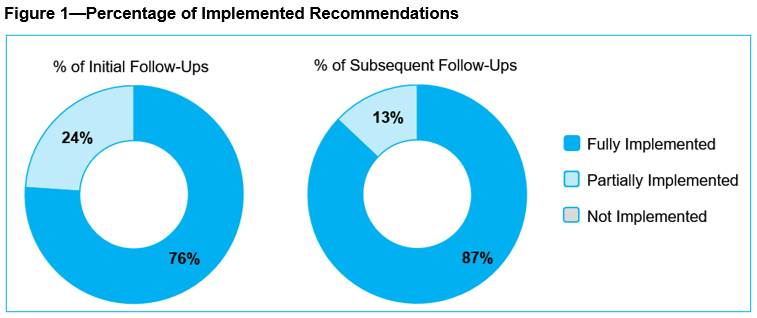
This section of the Report highlights the results of 15 follow-up audits, as well as summarizes how quickly government agencies addressed our recommendations and made process improvements.
As shown in the Figure 1 below, 76% of the audit recommendations in this Report were fully implemented after the initial follow-up (i.e., 2–3 years after original audit) at the various agencies. For agencies with subsequent follow-ups in this Report, 87% of audit recommendations have been fully implemented. We are pleased to see agencies acting on our recommendations in a timely manner, as this means public sector management is improving.
We were pleased to see the Saskatchewan Distance Learning Centre (Chapter 21) addressed all seven recommendations related to supporting Grades 10 to 12 students in completing distance education courses by our first follow-up audit. The Centre formalized a framework to guide course development and maintenance to help ensure courses are updated and renewed on a regular basis. The Centre also strengthened implementation of its marking and student inactivity policies.
For example, Centre management monitored teachers against a five-day target for completing marking of assignments to inform action plans for teachers with marking backlogs. The Centre also set targets for course completion rates for its various student groups and regularly reports results against those targets to the Board, along with reasons why students drop courses. This helps the Centre to develop action plans (e.g., increase academic advisor engagement, extend graduation plans) directed at root causes of incomplete courses.
However, further work is needed at some government agencies.
We did find the Saskatchewan Health Authority (Chapter 25) has further work to do to minimize employee absenteeism in Kindersley and area. Managers do not document monitoring of, or discussions held with, employees with excessive absenteeism (i.e., sick hours greater than 10% of their scheduled hours). About 25% of its staff in Kindersley and area had excessive absenteeism in 2024–25. The Authority is also still unable to complete meaningful analysis on absenteeism trends or patterns due to data limitations. This limits its ability to develop targeted strategies. In 2024–25, the Authority experienced actual sick time per employee of about 12.7 sick days compared to 10.25 days in 2018–19.
2025 Report Volume 2 Press Conference by Provincial Auditor Saskatchewan
Quick Links
- Audit Suggestions
- Audits of Public Accounts
- Potential Performance Audit Areas
- Social Media Terms of Use
- Senior Management Travel Expenses
- Frequently Asked Questions
